
Roofing Repair for School Buildings:
What Should You Look for When Evaluating a Flat Roof?
If you are responsible for a school building, you probably have a long list of things competing for your attention and your budget. The roof may not get much attention until there is a leak over a classroom, water dripping into a hallway, or ceiling tiles suddenly turning brown. But roofing repair for school buildings is much easier to manage when problems are identified early. At Weather Shield Roofing Systems™, we’ve been helping schools protect their commercial roofs for over 45 years, and one lesson comes up again and again: knowing what to look for can help you make better decisions before a small roofing problem becomes an expensive one.
This guide is designed to help school board members, facility directors, superintendents, and maintenance teams evaluate a school’s flat commercial roof and know when it may be time to bring in a commercial roofing professional.
What Should You Look for When Inspecting a School’s Flat Roof?
You do not have to be a commercial roofer to spot warning signs.
A simple visual roof inspection can help your school identify potential problems before they reach the classrooms below. However, always follow your district’s safety policies. If accessing the roof requires special equipment or presents a fall hazard, leave the inspection to a qualified commercial roofing contractor.
If you can safely inspect the roof, look for:
- Standing or ponding water
- Cracks, splits, or punctures in the roof membrane
- Loose or damaged flashing
- Open seams
- Bubbles or blisters in the roofing material
- Damage around HVAC equipment and roof penetrations
- Clogged drains, gutters, and scuppers
- Debris collecting on the roof
- Previous repairs that appear cracked or loose
- Areas where the roofing membrane is pulling away
You should also look inside the school.
Water stains on ceiling tiles, bubbling paint, musty odors, wet insulation, and unexplained moisture can all point toward a commercial roof leak.
The important thing is not to wait for water to start dripping.
A roof can allow moisture into the roofing system long before water becomes visible inside the building.
Does Standing Water Mean a School Roof Needs Repair?
Not necessarily, but it deserves attention.
Flat commercial roofs are not completely flat. They are designed with enough slope to move water toward drains and other drainage points.
When water remains on the roof for extended periods after a storm, there could be a drainage problem.
Check for clogged drains first. Leaves, branches, balls, trash, and other debris can block drainage on school roofs.
If drains are clear but water continues collecting in the same areas, a commercial roof inspection can help determine whether there is an issue with the roof’s slope, insulation, drainage system, or underlying roof deck.
Do not ignore recurring ponding water. Over time, standing water can contribute to roof deterioration and increase the chance of leaks.
Why Should You Pay Close Attention to Rooftop HVAC Equipment?
School buildings often have a lot happening on their roofs.
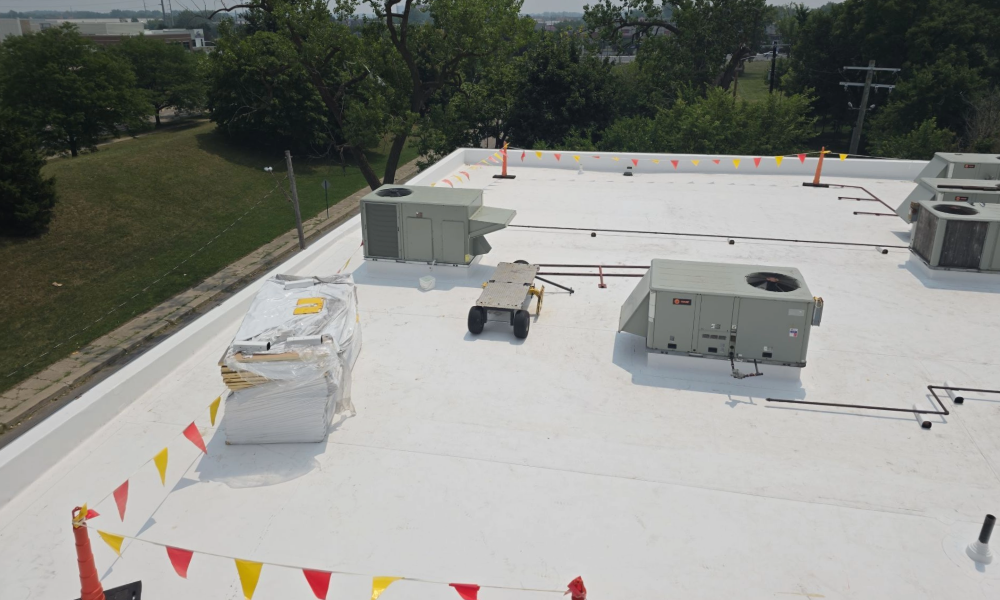
HVAC systems, vents, pipes, exhaust fans, skylights, hatches, and other equipment create penetrations through the commercial roofing system. Each penetration creates an area that needs to remain properly sealed.
These areas can also receive more foot traffic from maintenance crews and outside contractors.
When evaluating your school roof, pay close attention to the membrane, flashing, and sealants around rooftop equipment.
Also consider how people are moving across the roof.
If technicians regularly walk from a roof hatch to HVAC equipment, designated walk pads can help protect the roofing membrane from repeated foot traffic and reduce preventable roof damage.
How Can You Tell Where a School Roof Leak Is Coming From?
This is where things get tricky.
The spot where you see water inside the building is not always directly below the actual roof leak.
Water can enter through a damaged seam or penetration, travel through insulation or along structural components, and finally appear somewhere else inside the school.
That means simply patching the roof directly above a stained ceiling tile may not solve the problem.
Document what you see instead.
Take photos, record the room number, note when the leak occurred, and write down the weather conditions. Did it happen during heavy rain? Wind-driven rain? Snow melt? Does it happen every time it rains or only occasionally?
That information can make professional roof leak detection much more effective.
Should a School Repair or Replace Its Flat Commercial Roof?
A leaking roof does not automatically need to be replaced.
In many cases, targeted commercial roof repairs combined with proactive roof maintenance can extend the useful life of the existing roofing system.
The decision should be based on the actual condition of the roof.
Before approving a major roof replacement, school decision-makers should understand:
How old is the roof?
A roof approaching the end of its expected service life may require a different strategy than a relatively young roof with isolated damage.
How widespread is the damage?
One damaged flashing detail is very different from moisture spread throughout a large section of the roofing system.
Is the insulation wet?
Moisture trapped beneath the membrane can significantly affect repair and replacement decisions.
How often are repairs needed?
If the district is repeatedly spending money on emergency roof repair, it may be time to evaluate whether those repairs are still providing good value.
Can the roof’s lifespan reasonably be extended?
A professional roof inspection should help answer this question before the district commits to a large capital expense.
The goal should not automatically be to buy a new roof. The goal should be to determine the most cost-efficient way to protect the building and maximize the school’s existing roof investment.
What Questions Should School Board Members Ask a Commercial Roofing Contractor?
School board members do not need to know every technical detail about commercial roofing. They do need enough information to make an informed financial decision.
When reviewing a roof repair or replacement recommendation, ask questions such as:
- What specifically is wrong with the roof?
- Can you show us photos of the problem areas?
- Is moisture present underneath the roof membrane?
- Can the problem be repaired?
- How much useful roof life could repairs potentially preserve?
- What happens if we postpone this repair?
- Are there less expensive alternatives to replacement?
- Which repairs should be addressed immediately?
- Which repairs can be planned for a future budget cycle?
- What ongoing roof maintenance would help prevent additional damage?
A good commercial roofing contractor should be willing to explain the answers in language that school decision-makers can understand.
If every problem seems to lead immediately to “you need a new roof,” asking for additional evidence or another professional assessment can be worthwhile.
How Often Should School Buildings Receive Roof Inspections?
Routine commercial roof inspections can be especially valuable for schools because roofing expenses often need to fit into carefully planned annual budgets.
Rather than discovering a major problem unexpectedly, regular inspections give facility directors time to identify deterioration, prioritize repairs, and plan future capital expenses.
It is generally smart to evaluate the roof regularly and after major weather events.
Your maintenance team should also keep records of inspections, roof repairs, leaks, warranties, contractor visits, and photographs.
Over time, this roof history becomes extremely useful.
Instead of guessing whether a problem is new or recurring, you have documentation that helps your team and roofing contractor make better decisions.
How Can Preventive Roof Maintenance Save a School Money?
The biggest opportunity for roof cost savings is often preventing minor problems from becoming major ones.
Consider a small opening in a roof seam.
If it is identified early, the repair may be relatively simple. If it remains unnoticed for months or years, moisture may enter the insulation and potentially damage other components of the roofing system.
Now the school is dealing with more than a seam repair.
Proactive roof maintenance can also help school districts reduce disruptive emergency roof repairs. Nobody wants to discover a major roofing problem during a thunderstorm while students are in the building.
Programs such as our Max Life™ Roof Care approach focus on finding problems, prioritizing repairs, documenting roof conditions, and helping building owners maximize roof lifespan whenever practical.
For a school district, that information can also make long-term budgeting easier.
What is the Best First Step if You Are Concerned About Your School’s Roof?
Start with information.
Gather your roof’s age, repair history, warranty documents, leak records, photographs, and any previous inspection reports you can find.
Then have the roof evaluated by an experienced commercial roofing professional.
Ask for clear documentation of the roof’s condition and make sure you understand which problems are urgent, which can be repaired, and which can be monitored.
Most importantly, do not assume that seeing a roof problem automatically means your school needs an entirely new roof.
At Weather Shield Roofing Systems™, we believe commercial roofing decisions should be based on the actual condition of the roof and the long-term interests of the building owner. After more than 45 years of helping organizations manage commercial roofs, our goal remains simple: help customers find transparent, cost-efficient solutions that protect their buildings and maximize the life of their roofing investment.
If your school is dealing with leaks, recurring repairs, an aging flat roof, or questions about its remaining roof lifespan, our team can help you understand your options before you make a major capital decision.
Have questions about roofing repair for your school building? Contact Weather Shield Roofing Systems to schedule a conversation about your school’s commercial roof.

Andrew Schmidt
Account Executive
Andrew Schmidt brings 25 years of leadership experience in education—including as Deputy Superintendent for Flushing Schools—to his role at Weather Shield Roofing Systems. With a strong background in facilities management, he understands the importance of reliable, well-maintained roofs. Now, he helps building owners find practical, cost-effective roofing solutions, focusing on extending roof life and supporting Weather Shield’s mission: We Stop Roof Leaks!