
What is a Nuclear Roof Scan?
If you’ve ever had someone mention a “nuclear scan” for your commercial roof, you probably had the same reaction most building owners do.
Wait… nuclear?
You’re not crazy for pausing. Anything that even sounds radioactive should come with a little caution tape and a guy in a hazmat suit.
But here’s the truth: nuclear moisture testing is one of the most accurate ways to find trapped moisture in a commercial roof system — and it’s also one of the most regulated, expensive, and responsibility-heavy tools a commercial roofing contractor can bring to your building.
At Weather Shield Roofing Systems™, we’ve spent more than 45 years helping property managers and building owners get clear answers about their roofs — not guesses, not sales pitches, and definitely not “we’ll know more once we tear it off.” This is one of those topics where transparency matters, because the scan itself is only part of the story.
Let’s break down what a nuclear roof scan is, why it’s so tightly controlled, and how it compares to infrared roof scans.
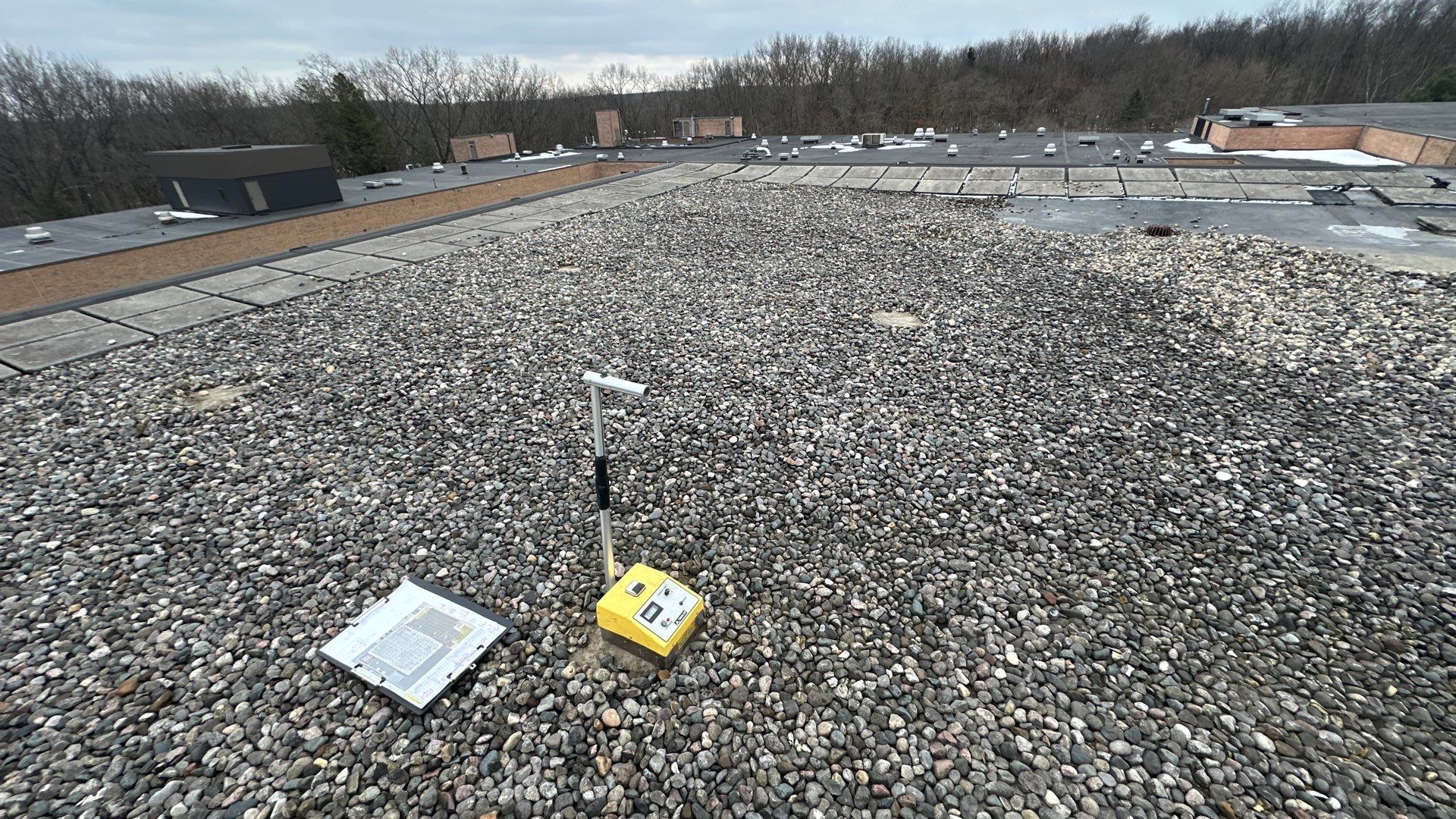
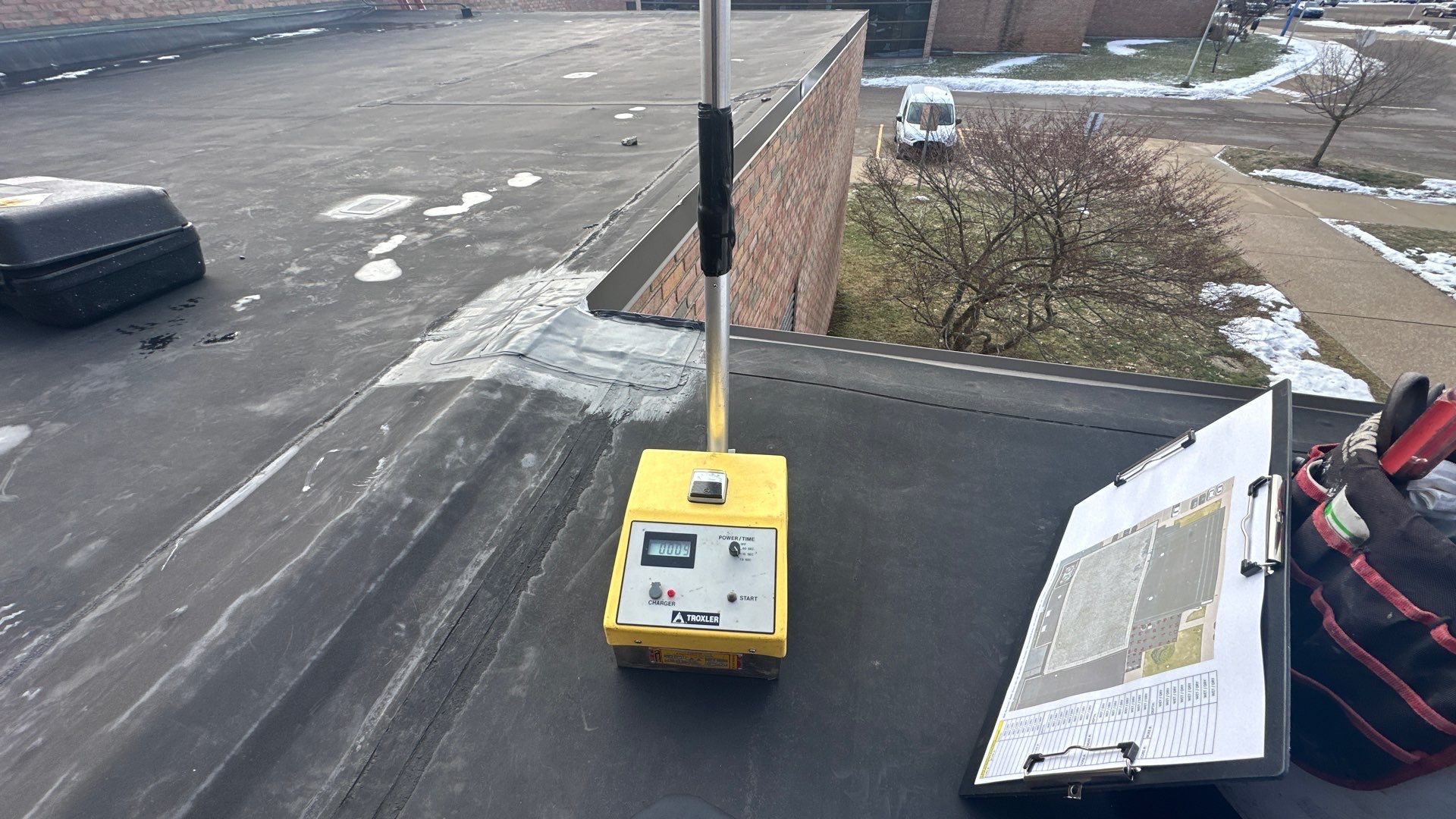
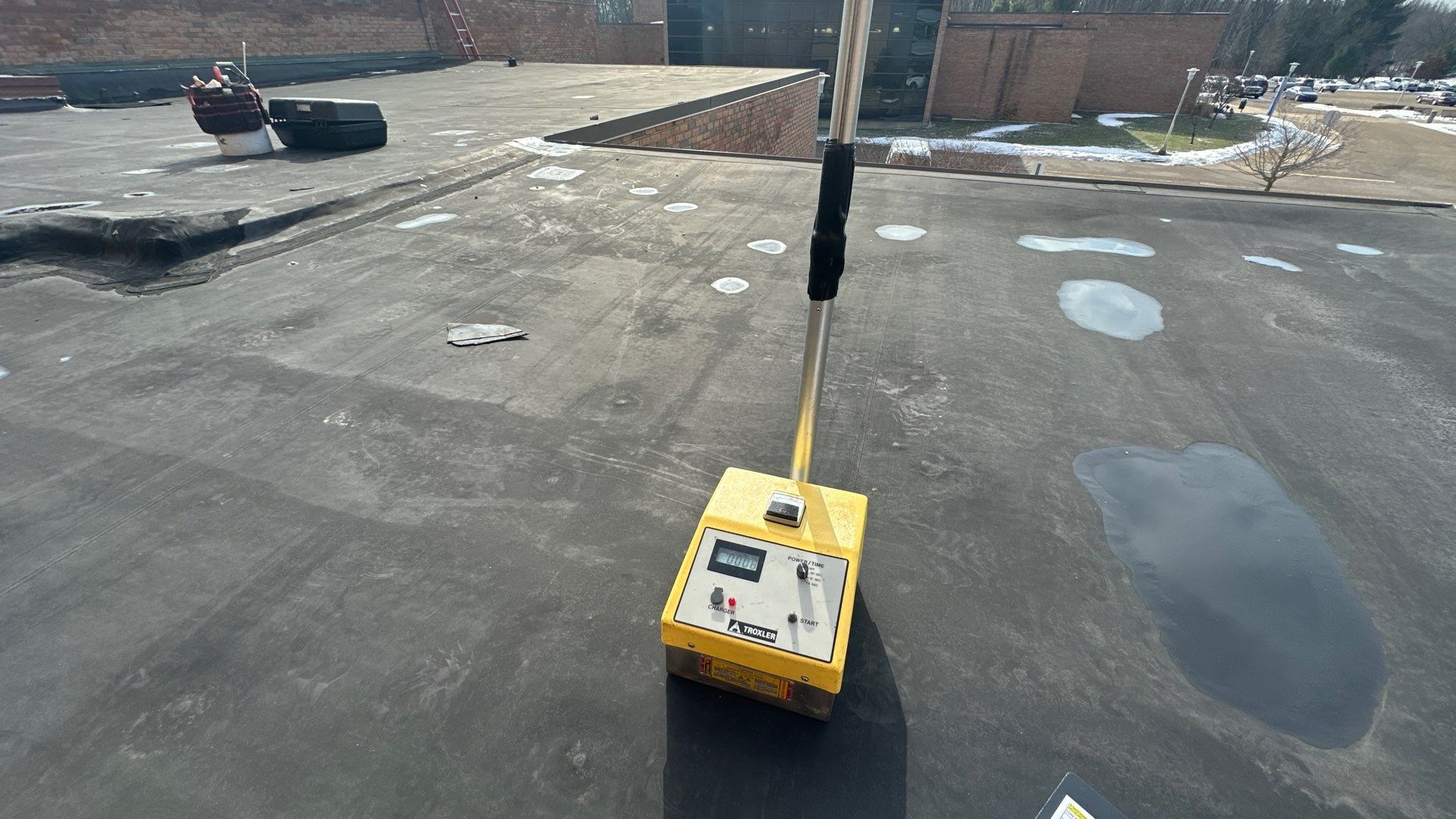
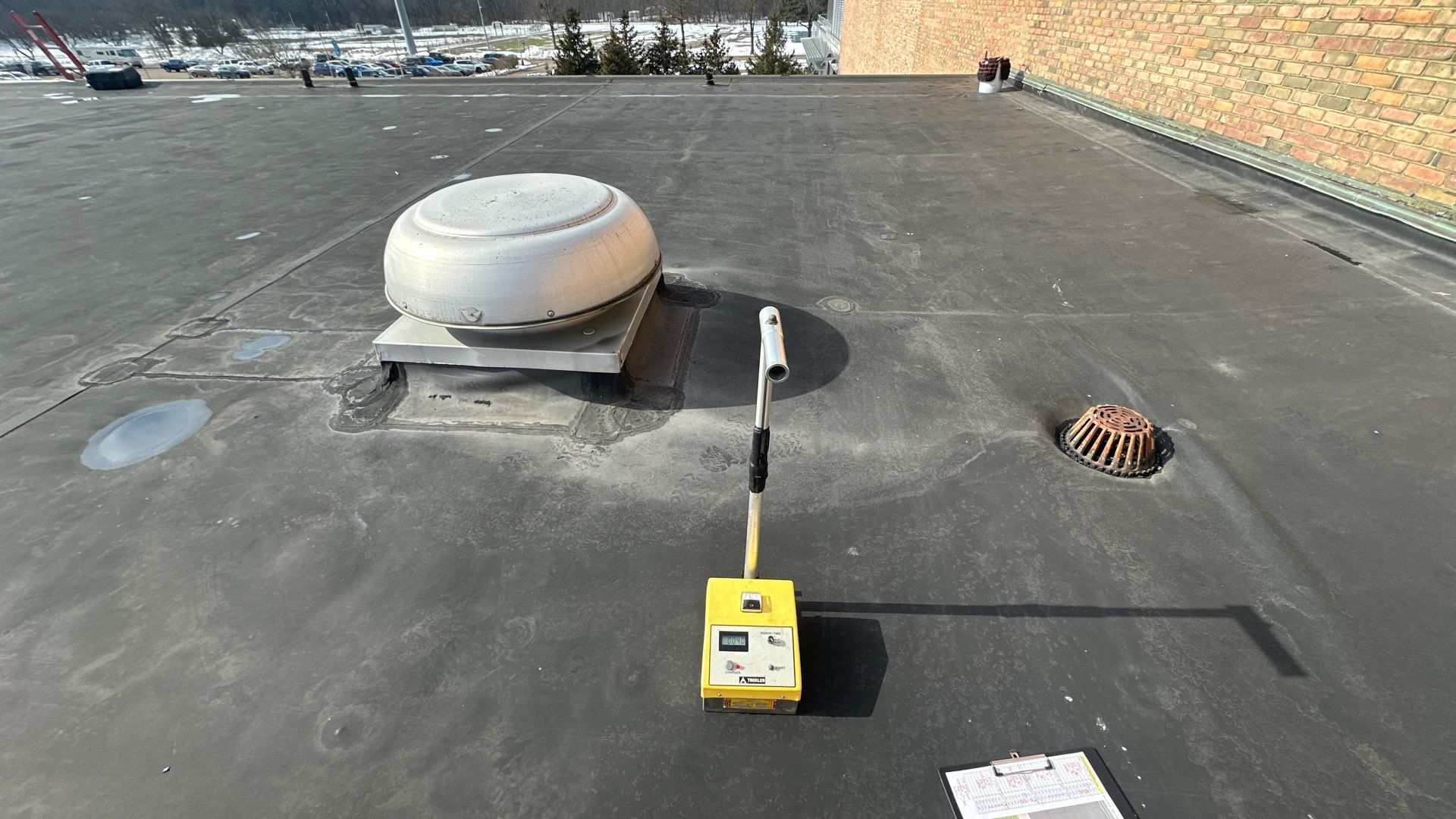
What does a nuclear roof scan show?
A nuclear roof scan (often called a nuclear moisture scan) uses a specially licensed gauge to detect moisture beneath the surface of a commercial roofing system.
Instead of just showing surface temperature differences, a nuclear scan gives actual density/moisture readings from below the membrane, often several inches deep. In practical terms, it helps us answer the question every building owner really cares about:
“How much of my roof is wet… and where?”
That matters because wet insulation loses its R-value, contributes to roof deterioration, increases energy costs, and can turn a manageable repair into a bigger replacement if it spreads.
Why does it involve “nuclear” anything?
Because the gauge contains a small amount of radioactive material that’s sealed and double-insulated inside the unit. It’s not loose, it’s not floating around in the air, and it’s not being “sprayed” into your roof.
But it is regulated, because if that material were ever compromised through serious mishandling, accident, or damage to the case, it could be dangerous.
That’s why nuclear moisture testing isn’t something a contractor casually tosses in the back of a pickup next to a ladder and a half-eaten sandwich.
Why nuclear roof scanning is expensive (and why that matters to you)
Here’s what most people don’t realize: the scanning equipment itself is a major investment.
These gauges typically cost in the range of $10,000 to $30,000+ (and depending on model and availability, they can climb higher). You might find used units, you might buy new, but either way, you’re not picking one up between trips to the hardware store.
But the purchase price is just the first hurdle. Owning and operating one means taking on:
- licensing requirements
- approved storage rules
- strict transport documentation
- state-by-state permissions
- audits and compliance procedures
In other words, you’re not just paying for a tool. You’re paying for a system of accountability built around that tool.
And yes — it can affect what a contractor charges and what kind of roofing services they can realistically offer.
NRC regulations: why contractors must document everything
The radioactive component inside the gauge is regulated by the Nuclear Regulatory Commission (NRC) and often by additional state agencies as well.
That oversight comes with a very specific chain-of-custody process.
When a nuclear gauge is owned and operated properly, it must be:
- stored in an approved facility
- signed out every time it leaves storage
- signed back in every time it returns
- tracked by serial number
- documented for every jobsite location it visits
It’s not “optional paperwork.” It’s mandatory compliance.
At Weather Shield, for example, every unit is tracked, and every movement is documented through a dynamic system so there’s always a clear record of where the device has been and where it’s going.
Transport is the biggest risk (and why emergency planning matters)
The biggest risk with nuclear moisture testing isn’t using the gauge on the roof. It’s transporting it.
That’s why licensed contractors must carry:
- a bill of lading
- a documented transport process
- an emergency plan
- required notifications and procedures in case of incident
The emergency plan isn’t there to scare anybody. It’s there because if the case were damaged in something like a vehicle accident or a drop event, there is a strict process that must be followed immediately.
In plain English: this is not a tool you want handled by someone who’s “pretty sure” they know what they’re doing.
So why use nuclear scanning at all?
Because when you’re trying to build a smart roof repair plan, moisture isn’t a theory. It’s a fact-based problem.
If your commercial roof has wet insulation, you need to know:
- how much is affected
- where it’s located
- whether moisture is isolated or spreading
- whether a repair makes sense or replacement is the wiser investment
A nuclear roof scan helps you avoid the two worst-case outcomes:
Replacing a roof that could have been repaired cost-effectively
Repairing a roof that’s hiding widespread wet insulation
That’s why accurate diagnostics are a key part of responsible roof maintenance and long-term roof lifespan planning.
What’s the difference between a nuclear roof scan and an infrared scan?
This is the question that comes up a lot:
“If infrared exists, why bother with nuclear scans?”
Let’s keep it simple.
Infrared roof scans read surface-level temperature differences.
Infrared scanning (including drone-based thermal imaging) looks for temperature patterns that suggest moisture.
It can be useful for identifying “hot spots” or “cold spots” on the surface that may indicate trapped water underneath.
But the key limitation is right there in the name:
It’s measuring heat, not moisture directly.
And most of what it captures is surface behavior. That can become a problem when:
- the roof has multiple layers
- wet insulation sits lower in the system
- the roof surface conditions (sun, wind, cloud cover) distort readings
Infrared can be helpful. But it can also miss what’s happening deeper down.
Nuclear moisture scans read deeper into the roof system
A nuclear scan can measure moisture conditions several inches below the surface (often described in the ballpark of 8–10 inches depending on the system and method).
Instead of a heat map, you get real numeric readings in a consistent grid pattern — typically something like a 10-foot by 10-foot grid.
That means you’re not just guessing based on temperature. You’re collecting data points across the entire roof.
Why core samples still matter (even with nuclear scans)
Here’s the part that separates careful roofing contractors from “scan-and-go” operators:
A nuclear scan is powerful — but it still needs physical confirmation.
That’s why we pair scan readings with core samples.
Core samples give you hard evidence of what’s actually in the roof assembly at specific points: membrane, insulation, moisture condition, and roof layers.
It’s the difference between:
“This looks wet.”
and
“This is wet, and here’s what the system is made of.”
If you’re making six-figure decisions about a commercial roof, you want the second sentence.
Why we plan tear-outs bigger than the exact wet reading
Another honest point: nuclear scan readings are taken at specific points — not across a wide radius.
So if you get a “confirmed wet” reading at a grid point, we typically plan for a 10’ x 10’ tear-out in that area (or an appropriate localized scope based on the system).
Why?
Two reasons:
- Placement factor: The gauge reads primarily below where it sits. Moisture could extend beyond that exact point.
- Time factor: It might be 3–6 months between the scan and the repair work. Weather keeps happening. Moisture can spread, especially if the roof is already failing.
If your roof is in rough shape, it’s not uncommon to find slightly more wet insulation during repairs than the scan showed months earlier. That’s not the scan failing — that’s water doing what water does.
The part most building owners appreciate: we often provide this at no cost
Nuclear scanning is a real expense for a contractor — equipment, compliance, training, documentation, audits, and the operational time it takes to handle it properly.
But when we provide it as part of an evaluation process, we do it because accurate information helps property owners make smarter decisions and avoids wasteful spending.
A roof doesn’t care about your budget. But good diagnostics can.
If you want the truth about your roof, you need the right testing
A commercial roof doesn’t usually fail all at once. It fails in layers, and moisture is the quiet troublemaker that accelerates everything.
A nuclear roof scan isn’t always necessary, but when moisture mapping matters, it can be one of the most accurate tools available — especially when paired with core samples and a contractor who takes the regulations seriously.
If you’re weighing roof repair versus replacement, dealing with recurring leaks, or trying to extend roof lifespan through smart roof maintenance, we can help you sort fact from guesswork.
If you want an honest assessment and a clear plan forward, reach out to our team of experts.
Related blog posts:
Understanding Nuclear Moisture Scans: The Key to Smarter Roofing Decisions
How Can Nuclear Moisture Scanning Equipment Help Find Roof Leaks?
Revolutionizing Commercial Roof Inspections with Infrared and Nuclear Scanning Technology
What is a Roof Core Sample?

Matt Case
Matt Case is Weather Shield’s Lead FRA, known for equal parts technical know-how and people-first leadership. He first joined Weather Shield in 2008 on an install crew, spending 3 years in the field. After eight years gaining additional experience elsewhere, Matt came back to Weather Shield, restarting as a service technician and working his way up through foreman, estimating, and a superintendent role in the service department. For the past 2+ years, he’s led and coached FRAs and field teams, focused on building up the people around him and passing on hard-earned knowledge across generations. What motivates him most is elevating his team—every day, every time.