
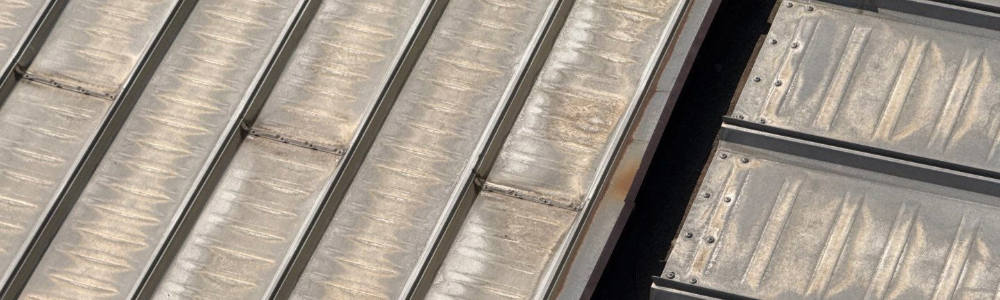
Commercial Metal Roof Repair: Common Problems, Repair Options and Warning Signs
Commercial metal roofing can deliver decades of reliable performance when contractors design, install, and maintain the system properly. However, metal roofs still require regular maintenance to perform at their best.
Over time, fasteners can loosen, sealants can deteriorate, and metal panels naturally expand and contract as temperatures change. In addition, new roof penetrations, damaged protective coatings, and developing rust can create weak points that allow water to enter the roof system. If left unaddressed, these small issues can lead to moisture damage in the insulation, roof deck, and even the occupied spaces below.
Fortunately, many commercial metal roof problems can be repaired or restored without replacing the entire roof. Instead, the best solution depends on accurately identifying the source of the leak, evaluating the condition of the metal panels, and determining how much moisture has already entered the roof assembly.
Why do commercial metal roofs leak?
Metal roof leaks most often develop at transitions, penetrations and attachment points rather than through the middle of an undamaged panel.
Common sources include:
- Loose or backed-out fasteners
- Deteriorated fastener washers
- Failed sealant
- Open panel seams
- End-lap separation
- Damaged flashing
- Pipe and equipment penetrations
- Ridge, rake and eave details
- Skylights
- Gutters and internal drainage
- Corrosion or punctures
- Improperly installed rooftop equipment
Metal expands and contracts as temperatures change. Over thousands of cycles, that movement can stress fasteners, seams and flashing details.
Exposed-fastener vs. standing-seam roof problems
Not all commercial metal roofs fail in the same way.
Exposed-fastener systems have screws installed through the panel into the structure below. Each fastener creates a potential water-entry point. Washers can deteriorate, screws can loosen, and holes can enlarge if panels move around the fastener.
Standing-seam systems conceal many fasteners beneath raised seams. They reduce the number of exposed penetrations but can still develop problems at clips, seams, end laps, curbs, and transitions.
Correctly identifying the system helps determine which repair methods are appropriate.
Warning signs that a metal roof needs attention
Facility teams should watch for:
- Rust or visible corrosion
- Missing, loose or crooked fasteners
- Cracked sealant
- Gaps at seams or laps
- Water stains beneath the roof
- Wet insulation
- Damaged panels
- Movement around penetrations
- Ponding near gutters or drains
- Repeated leaks after storms
- Patches that are peeling or separating
- Leaks that appear only during wind-driven rain can indicate a seam, flashing or transition problem rather than a simple hole.
Why simply tightening screws may not fix the leak
Although loose screws are common on commercial metal roofs, simply tightening every visible fastener does not always solve the problem. Over time, the fastener hole may enlarge, the washer may crack or wear out, or the metal panel itself may become distorted. As a result, the fastener may no longer grip the structural member securely. In addition, overtightening a screw can compress or split the washer, creating a new entry point for water. Instead, a long lasting repair often requires replacing the fastener with the correct size and type, repairing or addressing the enlarged hole, and confirming that the surrounding panel remains structurally sound.
How are commercial metal roofs repaired?
The repair scope depends on the roof condition and leak source.
Possible repairs include:
- Replacing failed fasteners
- Repairing or replacing damaged panels
- Reinforcing seams and end laps
- Rebuilding flashing
- Correcting penetrations
- Treating corrosion
- Repairing gutters and drainage
- Replacing closures
- Installing compatible sealant
- Removing and replacing wet insulation in affected areas
Generic caulk applied over a dirty or moving joint rarely provides a dependable long-term solution. Surfaces need to be prepared, and materials need to accommodate the movement expected at that detail.
When does a metal roof coating make sense?
A coating system may extend the life of an eligible commercial metal roof. A complete restoration typically includes repairs before the coating is applied.
The process may involve:
- Cleaning the roof
- Removing or treating corrosion
- Replacing failed fasteners
- Reinforcing seams and penetrations
- Performing adhesion tests
- Applying the specified coating thickness
A coating can protect panels and seal properly prepared details, but it cannot restore structurally unsound metal or correct every movement problem.
When is a metal-roof retrofit appropriate?
Some aging metal roofs can receive a retrofit system installed over the existing panels. Depending on the building and design, the new assembly may include insulation, a cover board and a single-ply membrane.
A retrofit can:
- Reduce the need for complete tear-off
- Improve thermal performance
- Create a continuous roofing surface
- Address recurring fastener and seam problems
- Minimize disruption inside the building
Engineering, attachment, condensation control, drainage, curb heights and building-code requirements must all be evaluated. A retrofit should be designed as a complete assembly rather than treated as a simple overlay.
How do you find a leak in a commercial metal roof?
The location of interior water does not always reveal the rooftop entry point. Water can move along purlins, insulation, panels, and structural members.
A professional investigation may include:
- Interior inspection
- Review of the leak history
- Rooftop visual assessment
- Seam and fastener examination
- Controlled water testing
- Moisture scanning
- Core or insulation sampling
The technician should also inspect walls, HVAC equipment, skylights, and plumbing because the water may not originate in the roof panels.
Repair, restore, retrofit or replace?
The right option depends on the extent of deterioration.
Repair may be appropriate when:
- Leaks are isolated
- Panels remain structurally sound
- Corrosion is limited
- Flashing or fastener problems are localized
- Moisture has not spread widely
Restoration may be appropriate when:
- The roof remains attached and stable
- Widespread surface weathering can be prepared
- Wet materials are limited and removable
- Seams and fasteners can be reinforced
- Adhesion testing supports the proposed coating
Retrofit may be appropriate when:
- The metal panels can remain in place
- The structure can support the new assembly
- A membrane system can address recurring leak points
- Insulation and energy improvements are desired
Replacement may be necessary when:
- Panels are structurally deteriorated
- Corrosion is widespread
- The roof or supporting components have failed
- Moisture damage is extensive
- A restoration or retrofit cannot be attached reliably
How much does commercial metal roof repair cost?
Costs vary based on:
- Roof size and height
- Access
- Metal-roof type
- Number of failing fasteners
- Extent of corrosion
- Panel availability
- Flashing complexity
- Amount of wet insulation
- Coating or retrofit scope
- Operational restrictions
The most useful estimate starts with a defined problem and documented scope. A low-cost repair based on assumptions may not stop the leak or protect the surrounding assembly.
Protect the roof after repairs
After the immediate issue is corrected, ongoing inspections can help facility managers catch movement, corrosion and drainage problems earlier.
Maintain records of:
- Leak locations
- Replaced fasteners
- Panel and flashing repairs
- Coating applications
- Rooftop equipment work
- Moisture findings
- Photographs
- A planned approach can extend roof life and help the organization prepare for future restoration or replacement.
Get a clear diagnosis before choosing a system
Commercial metal roof repair is not one-size-fits-all. The correct solution may be a small repair, a broader restoration, a membrane retrofit, or replacement.
Weather Shield Roofing Systems evaluates the source of the problem and the condition of the entire assembly before recommending the next step. We focus on repairing what can be repaired and replacing only when the evidence supports it.
Request a commercial metal roof inspection to get a documented assessment and a practical plan for your building.

Kyle Bruinsma
Account Executive
Since 2019, Kyle Bruinsma has delivered high-quality, cost-effective commercial roofing solutions at Weather Shield Roofing Systems. As both a roofing professional and commercial property investor, he brings a unique perspective to each project—treating every building like his own. Kyle values the strong team culture at Weather Shield, where everyone works together to keep customers dry.